![CA-StateBar_Logo_Horizontal_White_LargeSeal_.png]](https://info.calbar.ca.gov/hs-fs/hubfs/CA-StateBar_Logo_Horizontal_White_LargeSeal_.png?height=50&name=CA-StateBar_Logo_Horizontal_White_LargeSeal_.png)
-
(1.1) What is the purpose of the Client Trust Account Protection Program (CTAPP)?
-
(1.3) What are entrusted funds and how must they be handled?
-
(1.5) What measures are the State Bar taking to ensure the information reported for CTAPP is secure?
-
(2.1) What are a lawyer’s obligations regarding entrusted funds?
-
(2.2) Who is required to complete the CTAPP reporting requirements?
-
(2.3) Who is NOT required to complete the CTAPP reporting requirements?
-
(2.4) What are the consequences of noncompliance with the requirements of client trust reporting?
- (3.1) Screening Question
- (3.2) Step 1: Annual Client Trust Account Reporting
- (3.3) Step 2: Account Registration
- (3.4) Step 3: Self-Assessment
- (3.5) Final Declaration
Related Rules
CTAPP Overview
(1.1) What is the purpose of the Client Trust Account Protection Program (CTAPP)?
CTAPP is a proactive regulatory program designed to:
- Protect the public by ensuring proper accounting and safeguards for client and third-party funds entrusted to attorneys; and
- Educate, support, and assist attorneys in complying with the ethical and accounting requirements of managing client trust accounts.
Client Trust Account Protection Program webpage
California Rule of Court, rule 9.8.5
(1.2) What are the CTAPP requirements?
CTAPP includes an annual reporting obligation that is required to be completed by almost all licensees. (See FAQ 2.2 for more information on who must comply and FAQ 2.3 for who is exempt from CTAPP.) During each billing cycle, licensees are required to complete:
- Annual client trust account reporting (Cal. Rules of Court, rule 8.5(a)(1)(A));
- Annual trust account registration (Cal. Rules of Court, rule 8.5(a)(1)(B));
- Annual client trust account self-assessment (Cal. Rules of Court, rule 9.8.5(a)(2)(A)); and
- Annual client trust account certification of compliance (Cal. Rules of Court, rule 8.5(a)(1)(A)).
Licensees must also submit a declaration saying the information they provided is true and correct.
CTAPP also includes:
- Public education and client outreach regarding attorney responsibilities and the rights of clients;
- Enhanced legal education on client trust account management for attorneys, such as the newly released Practical Trust Account Reconciliation course, which includes practical guidance on CTA recordkeeping and monthly reconciliations, and best practices guides;
- Compliance reviews of selected lawyers by a certified public accountant to ensure adherence to client trust account management requirements; and
- Where appropriate based on the results of the compliance reviews, investigative audits of the licensee’s trust accounts.
State Bar Rules, Title 2, Division 1, rule 2.5
Client Trust Accounting Resources
(1.3) What are entrusted funds and how must they be handled?
All funds received by a lawyer in connection with legal representation in which a client or a third party has an interest are funds that must be deposited in a trust account.
Examples include advances for fees received from clients (until they are earned by the lawyer), funds of others that are being held for disbursement at a later time, personal injury awards, and litigation settlements.
Client and third-party funds must be held in either an IOLTA or non-IOLTA type client trust account. The definitions of each are as follows:
IOLTA—An attorney or firm that holds funds for a client or third party that are nominal in amount or are held for too short a time to earn interest income for the benefit of the client or third party in excess of the cost to hold the funds in a separate account is required to place those funds in an IOLTA account. (Bus. & Prof. Code, § 6211, subd. (a)). A California IOLTA account must be established and maintained with an eligible institution that offers IOLTA accounts that meet certain requirements. The State Bar website has a list of IOLTA-eligible institutions.
Non-IOLTA—An attorney or firm that holds funds for a client or the benefit of a single party in a matter that is large enough to generate more than nominal interest, or an attorney who holds funds for a single party for an extended period must hold such funds in a non-IOLTA trust account. An example would be funds held by the administrator of a family trust. The attorney must use a non-IOLTA account because these entrusted funds will earn interest in excess of the costs to maintain the account. The interest earned goes to the client or third party. (Bus. & Prof. Code, § 6211, subd. (b)).
When registering a client trust account as part of CTAPP, you must identify the trust account type. The account will either be IOLTA or non-IOLTA; an account will never be both. The account type was established at the time the account was opened and does not change. A California IOLTA must bear the State Bar of California’s Taxpayer Identification Number to ensure that interest or dividends generated by this account will be paid to the State Bar’s IOLTA program. A non-IOLTA will bear the Social Security Number or Tax ID number of the client or third party.
Rule of Professional Conduct 1.15
(1.4) What is the deadline for CTAPP reporting?
The CTAPP reporting deadline is the same as the licensee’s deadline for paying their license fees. (Rule 2.5(C) of the Rules of the State Bar). The annual renewal cycle deadline is March 30. This is also the deadline for other requirements (e.g., MCLE compliance, etc.). (Rule 2.11 of the Rules of the State Bar). For new attorneys, the deadline is forty-five days from the invoice date for their fees. (Rule 2.12 of the Rules of the State Bar).
State Bar Rules, Title 2, Division 1, rule 2.5
State Bar Rules, Title 2, Division 2, rule 2.11
State Bar Rules, Title 2, Division 2, rule 2.12
(1.5) What measures are the State Bar taking to ensure the information reported for CTAPP is secure?
The State Bar takes reasonable precautions and has security measures in place to protect the personal information we collect and maintain against loss, unauthorized access, use, modification, or disclosure. We take the following measures to secure the information that is stored within our applications:
- Protecting the security of individuals’ personal information during transmission by using encryption protocols and software.
- Storing personal information in secure locations in an encrypted format.
- Ensuring staff is trained on procedures for the management and release of personal information. This information can only be accessed by staff whose work requires it.
- Conducting periodic audits to ensure that proper information management policies and procedures are being followed.
General Requirements for Lawyers
(2.1) What are a lawyer’s obligations regarding entrusted funds?
A lawyer in possession of client or third-party funds and property is a fiduciary. A lawyer must safeguard and segregate those funds and not commingle them with the lawyer's personal or business accounts. (See FAQ 1.3, above, for a description of the two types of trust accounts a lawyer may open to hold client or third-party funds.)
A lawyer must report timely and completely to their client regarding the status and accounting of client funds. A lawyer’s obligations regarding entrusted funds and property are set out in rule 1.15 of the Rules of Professional Conduct. In addition, under rule 1.4 of the Rules of Professional Conduct, a lawyer must keep their client reasonably informed about significant developments related to a client’s representation. Comment [1] to this rule specifies that a lawyer’s receipt of funds on behalf of a client ordinarily is a significant development requiring such communication with the client.
Rule of Professional Conduct 1.4
Rule of Professional Conduct 1.15
(2.2) Who is required to complete the CTAPP reporting requirements?
With very few exceptions (see FAQ 2.3 below), all licensees who held an active license status at ANY time during the reporting period must complete the CTAPP reporting requirements. For 2026, the reporting period is January 1–December 31, 2025. This includes those licensees whose status changed to voluntary inactive at any time during the reporting period.
(2.3) Who is NOT required to complete the CTAPP reporting requirements?
The only licensees who are exempt from the annual reporting requirement are licensees who were on voluntary inactive status for the entirety of the reportable time period. All other licensees, including those who were active, suspended, or not entitled to practice law at any point in the reportable time period are required to complete the CTAPP reporting requirements for that reportable time period.
Rules of the State Bar, Title 2, Division 1.5, rule 2.5
(2.4) What are the consequences of noncompliance with the requirements of client trust reporting?
A license who fails to satisfy the requirements of CTAPP and its associated rules by the deadline will be assessed a noncompliance penalty. If the licensee still does not comply, they will be enrolled as an inactive licensee of the State Bar under the rules adopted by the Board of Trustees of the State Bar. Inactive enrollment imposed for noncompliance with the requirements of this program is cumulative and does not preclude a disciplinary proceeding or other actions for violations of the State Bar Act, the Rules of Professional Conduct, or other applicable laws. (See FAQ 2.12, below, for a discussion of the unauthorized practice of law by inactive licensees.)
(2.5) How do I know if I have completed my CTAPP reporting?
Your reporting is complete if:
- You answered “no” to the CTAPP Screening Question and submitted your final declaration; or
- You answered “yes” to the CTAPP Screening Question and:
- Completed Step 1 (Annual Client Trust Account Reporting);
- Registered your trust accounts in Step 2 (Account Registration) or confirmed your firm registered your trust accounts on your behalf through Agency Billing and you or your firm updated the year-end account balance for all registered trust accounts;
- Completed Step 3 (Self-Assessment);
- Completed Step 4 (Annual Certification of Compliance); and
- Submitted your Final Declaration.
You can verify your compliance status by logging in to My State Bar Profile and reviewing your Compliance Dashboard. Each box on the dashboard displays reminders related to each of your annual requirements, including your current CTAPP status. Click the blue button on the relevant tile to complete outstanding tasks.
If your individual reporting is complete, you can review your responses and determine if your firm has registered accounts on your behalf using the “View a Summary of your CTAPP Annual Reporting” link on the CTAPP Annual Reporting tile on the Compliance Dashboard page. You will not invalidate your declaration by reviewing this summary.
(2.6) I have already completed my reporting, but I want to change an answer during the annual CTAPP reporting period. How do I do that?
If you have already completed your CTAPP reporting for the current period and you want to change an answer before the reporting deadline, you can access the CTAPP reporting page by logging in to My State Bar Profile. On your Client Trust Reporting page (third blue tab at the top), click the CTAPP Annual Reporting tile. You can click through the pop-up warning that says you have already submitted your CTAPP Annual Reporting declaration and that you will have to resubmit your declaration, or you will be out of compliance. NOTE: Even if you make no changes, be sure to click all the way through and resubmit your declaration.
(2.7) I’m not involved with the firm’s client trust accounting; why do I have to report on client trust accounts?
If a lawyer is a signatory on a trust account, exercises managerial or primary administrative oversight for a trust account or is otherwise responsible for complying with any of the requirements or prohibitions in rule 1.15 of the Rules of Professional Conduct — other than the disclosure and agreement requirements in rule 1.15(b) pertaining to depositing a flat fee paid in advance into a lawyer’s or law firm’s operating account — the lawyer is responsible for those funds. The lawyer remains responsible even if other lawyers are also responsible for the safekeeping of funds. The lawyer is ultimately responsible even if nonlawyers are assigned certain accounting tasks for those funds; for example, bookkeeping and banking related to client trust accounts. (See Rules Prof. Conduct, rule 5.3.)
Accounting and recordkeeping activities are only one part of a lawyer’s duties to properly handle entrusted funds. Other duties include, for example, the responsibility for giving notice to the client or other person that funds were received on behalf of the client or other person and identifying and resolving disputes about entitlement to trust funds. These duties ordinarily are not the job of a firm’s bookkeeper. All of these responsibilities are considered nondelegable duties. The proactive regulation, reporting, and monitoring of CTAPP are intended to promote a lawyer’s compliance and prevent avoidable financial harm to clients. The only aspect of CTAPP reporting that can be fulfilled by the lawyer's firm is the annual registration of client trust accounts by a firm or organization that is registered with the State Bar’s Agency Billing platform.
Rule of Professional Conduct 5.3
(2.8) I don’t handle entrusted funds. Do I have to report?
If you do not maintain a trust account, a trust account is not maintained on your behalf, and you do not need a trust account because you are not responsible for complying with any of the requirements or prohibitions in rule 1.15 — other than the disclosure and agreement requirements in rule 1.15(b) pertaining to depositing a flat fee paid in advance into a lawyer’s or law firm’s operating account — you can answer “no” to the Screening Question: “At any point during the reporting period of January 1, 2025–December 31, 2025, or, if you are a new licensee who must pay your initial license fees pursuant to rule 2.12 of the Rules of the State Bar, from your date of admission through the following December 31, 2025, or the due date for payment of fees, whichever is earlier, were you responsible for complying with any of the requirements or prohibitions governing the safekeeping of funds of clients and other persons under rule 1.15 of the California Rules of Professional Conduct?” After submitting that response and declaring the information is true, your compliance with CTAPP will be deemed complete.
If your practice does not require a client trust account, you do not need to open one to report it to the State Bar as part of the CTAPP requirements. If you have questions about using trust accounts, including whether you are responsible for complying with any of the requirements or prohibitions in rule 1.15 or whether you need a trust account, please contact the State Bar’s Ethics Hotline research service at 800-238-4427 (toll-free in California). The Ethics Hotline might be able to provide helpful citations and resource references. The Ethics Hotline cannot provide legal advice, nor tell you how to comply with any of the CTAPP requirements, including the self-assessment.
Rule of Professional Conduct 1.15
(2.9) I have a client trust account, but I don’t have any client funds in it. Do I have to report it?
Yes. Even if you do not currently hold funds in your client trust account, you must still report and register the account. Further, regardless of whether there are client funds, third-party funds, or no funds in a trust account, an attorney has the Client Trust Account obligations set forth in the standards in rule 1.15.
The definition of a client trust account is “any bank account or accounts opened to receive or hold funds in accordance with rule 1.15(a) of the Rules of Professional Conduct, regardless of the amount of funds in the account, and includes, but is not limited to, any IOLTA account under Business and Professions Code section 6211, subdivision (a) where the interest is paid to the State Bar; and any accounts established under Business and Professions Code section 6211, subdivision (b) where the interest is payable to a client or other person.”
Rule of Professional Conduct 1.15
State Bar Rules, Title 2, Division 1, rule 2.5
Business and Professions Code section 6211
(2.10) I do not maintain my own trust account, but I work for a firm that has a trust account. How do I know if the firm trust account is maintained “on my behalf?”
Rule 1.15 requires attorneys who handle trust funds to hold those funds in one or more interest-bearing bank accounts labeled as a “Trust Account,” or words of similar import. If, at any point in the reporting period, you were responsible for complying with any of the requirements or prohibitions in rule 1.15 — other than the disclosure and agreement requirements in rule 1.15(b) pertaining to depositing a flat fee paid in advance into a lawyer’s or law firm’s operating account — (e.g., responsibilities for the safekeeping of funds, identifying and discharging of liens, notifying clients that funds have been received, etc.), regardless of whether someone else ultimately performed this function, you are required to have a trust account. If the firm’s trust account(s) are available funds for the deposit of your client’s funds, then that trust account/those trust accounts are maintained, at least in part, on your behalf.
Therefore, if, at any point in the reporting period, you were responsible for complying with any of the requirements or prohibitions in rule 1.15 — other than the disclosure and agreement requirements in rule 1.15(b) pertaining to depositing a flat fee paid in advance into a lawyer’s or law firm’s operating account — you should answer, “Yes, a firm or organization I am currently employed by or in practice with . . . ,” “Yes, however, I am no longer employed by or in practice with the firm or organization . . . ,” or both to at least one of the questions in CTAPP Step 1 (Annual Client Trust Account Reporting) and thereafter complete the remaining CTAPP requirements. If your firm administrator will register the IOLTA and/or non-IOLTA account details on your behalf through the State Bar's Agency Billing application, you may check the checkbox to indicate that in Step 2 (Account Registration).
If you have further questions about trust accounts, including whether you are responsible for complying with rule 1.15, whether you need a trust account, the rules of trust accounting, the recent changes to the rules regarding the safekeeping of funds, etc., please contact the State Bar’s Ethics Hotline research service at 800-238-4427 (toll-free in California). The Ethics Hotline cannot provide legal advice, nor tell you how to comply with any of the CTAPP requirements, including whether to answer “yes” or “no” in any portion of the CTAPP reporting requirements.
(2.11) I am a licensed attorney and also a nonlegal professional (e.g., probate trustee, investment advisor, real estate agent, business manager, etc.), do the Rules of Professional Conduct (e.g., rule 1.15) apply and do I need to report and register any trust account as part of CTAPP?
When a licensee performs both legal and non-legal professional services for a client, the licensee is subject to the Rules of Professional Conduct with respect to all of those services. (See Cal. State Bar Formal Opn. Nos. 1982-69, 1995-141, and 1999-154).
Therefore, a key question is whether the licensee is performing legal services and, as a result, is subject to rule 1.15 and the other Rules of Professional Conduct. If not, and the licensee is merely a real estate broker who happens to be a lawyer, rule 1.15 may not apply. Similarly, if the licensee is a trustee but did not perform any legal services related to the creation of the trust and does not perform any legal services related to the trust, rule 1.15 may not apply. On the other hand, if the licensee is acting as both the real estate lawyer and broker, and the lawyer receives entrusted funds from, or for, the transaction, rule 1.15 would apply, and any accounts need to be reported and registered as part of the licensee’s CTAPP compliance. The same is true of lawyers providing other non-legal professional services, regardless of whether they, as a trustee, for example, report to the probate court.
If you have further questions on dual capacity, including whether you are responsible for complying with any of the requirements or prohibitions in rule 1.15, please contact the State Bar’s Ethics Hotline research service at 800-238-4427 (toll-free in California). The Ethics Hotline cannot provide legal advice, nor tell you how to comply with any of the CTAPP requirements, including whether to answer “yes” or “no” in any portion of the CTAPP reporting requirements.
(2.12) I was placed on involuntary inactive status for failure to comply with the CTAPP reporting requirements. Now what?
While a licensee is on inactive status, that licensee cannot practice law. An inactive licensee who engages in the practice of law may be guilty of a misdemeanor. (See Bus. & Prof. Code, §§ 6125–6126, 6068, subd.(a), & 6106. See also In the Matter of Burke (Review Dept. 2016) 5 Cal. State Bar Ct. Rptr. 448.) Additionally, a licensee on inactive status may have a duty to inform their client(s) or a tribunal that they are ineligible to practice law. (See Rules of Professional Conduct 1.4 and 3.3.) If you have further questions about the unauthorized practice of law, please contact the State Bar’s Ethics Hotline research service at 800-238-4427 (toll-free in California). The Ethics Hotline cannot provide legal advice, nor tell you how to comply with any of the CTAPP requirements, including whether to answer “yes” or “no” in any portion of the CTAPP reporting requirements.
Reinstatement of your license requires payment of any applicable fees, completion of the past due CTAPP reporting requirements, and applying for reinstatement. To submit payment of applicable fees, please log in to your My State Bar Profile and click the “Pay Fee” link on the CTAPP Annual Reporting tile on your Compliance Dashboard or click the blue “Make a payment” button on the Profile Summary page to go to the "Annual Fee” page. You should go to the Annual Fee page to pay outstanding fees even if you have already paid your annual licensing fee for 2026. From there, click the blue “Calculate and pay my fees” button to see a breakdown of the fees owed. Click continue and follow the steps to complete your payment.
If you were involuntarily enrolled as inactive for noncompliance in 2026, you can complete your CTAPP reporting in My State Bar Profile and then complete and submit the first page of the CTAPP Noncompliance Reinstatement Form. If you were involuntarily enrolled as inactive for CTAPP noncompliance in 2023, 2024 or 2025, you will need to complete and submit the first page of the CTAPP Noncompliance Reinstatement Form and the attached CTAPP reporting forms for all missing years.
(2.13) How do I report changes to my trust accounts outside of the annual CTAPP reporting period (rule 2.2(C) of the Rules of the State Bar)?
A lawyer must report any changes to their client trust account to the State Bar within 30 days. A lawyer may add or close an account using the 30-day reporting window in My State Bar Profile, and a firm administrator may add or close an account or add or remove an attorney from an account through the 30-day reporting window in the Agency Billing platform. When a firm administrator adds a new attorney or removes an attorney from a trust account, they provide the effective date and reason for the disassociation as part of the reporting.
State Bar Rules, Title 2, Division 1, rule 2.2
Specific Questions About the CTAPP Reporting and Registration Steps
(3.1.) Screening Question
(3.1.1) What does “responsible for complying with any of the requirements or prohibitions governing the safekeeping of funds of clients and other persons under rule 1.15 of the California Rules of Professional Conduct” mean?
A licensee is “responsible for client funds and funds entrusted by others under the provisions of rule 1.15 of the Rules of Professional Conduct” within the meaning of this rule if, at any point during the reporting period, they acted as a signatory on a trust account—even if there was no money in the account, exercised managerial or primary administrative oversight for a trust account, or were otherwise responsible for complying with any of the requirements or prohibitions in rule 1.15 of the Rules of Professional Conduct – other than the disclosure and agreement requirements in rule 1.15(b) pertaining to depositing a flat fee paid in advance into a lawyer’s or law firm’s operating account. The requirements and prohibitions in rule 1.15 are not limited to banking and recordkeeping duties and include, for example, the responsibility for giving notice to the client or other person that funds were received on behalf of the client or other person and the duty to identify and discharge liens.
Lawyers who were responsible for entrusted funds in the reporting period must also register, or have their firm register through the State Bar’s Agency Billing application, all client trust accounts, take a self-assessment of client trust account management practices, and certify their compliance with requirements of rule 1.15 of the Rules of Professional Conduct.
State Bar Rules, Title 2, Division 1, rule 2.5
Rule of Professional Conduct 1.15
(3.1.2) Am I responsible for complying with any of the requirements or prohibitions governing the safekeeping of funds of clients and other persons under rule 1.15 of the California Rules of Professional Conduct?
A lawyer who has no responsibility to comply with any of the requirements or prohibitions in rule 1.15 and a lawyer who is responsible for complying only with the disclosure and agreement requirements in rule 1.15(b) pertaining to depositing a flat fee paid in advance into a lawyer’s or law firm’s operating account, can comply with their reporting requirements by answering “no” to the screening question as to whether they were responsible for complying with any of the requirements or prohibitions governing the safekeeping of funds of clients and other persons under rule 1.15 of the California Rules of Professional Conduct and thereafter submitting their declaration. Lawyers who have no such responsibilities include:
- A government lawyer-employee who is not responsible for the safe keeping of entrusted funds;
- An in-house counsel who is employed by their client and does not receive or hold client funds or funds entrusted by others;
- Law professors who do not represent clients that involve any entrusted funds and do not otherwise receive or hold entrusted funds;
- A lawyer in a large firm who only performs document review, has no interaction with any clients, and has no responsibilities to carry out any of the duties under rule 1.15;
- A lawyer who bills for fees and costs after completion of the work and therefore does not take advance fees and their practice does not involve the receipt of any other funds in which a client or third party has an interest (e.g., client settlement funds, etc.); and
- A lawyer who does not receive or hold any entrusted funds except for flat fees paid in advance and properly deposited into a lawyer’s or law firm’s operating account in accordance with the disclosure and agreement requirements in rule 1.15(b) of the Rules of Professional Conduct.
State Bar Rules, Title 2, Division 1, rule 2.5
Rule of Professional Conduct 1.15
(3.2) Step 1: Annual Client Trust Account Reporting
(3.2.1) What is the difference between question 1 (IOLTAs) and question 2 (non-IOLTAs) in Step 1?
Question 1 asks whether, to comply with the requirements or prohibitions governing the safekeeping of funds of clients and other persons in rule 1.15 of the California Rules of Professional Conduct, you maintained — or anyone maintained on your behalf — any trust account under Business and Professions Code section 6211, subdivision (a) where the interest is paid to the State Bar, also known as an Interest of Lawyer’s Trust Account (IOLTA), or a similar pooled trust account in another jurisdiction?
Question 2 asks the same question about trust accounts under Business and Professions Code section 6211, subdivision (b) where the interest is payable to a client or other person or similar accounts, also known as non-IOLTA trust accounts, or a similar trust account in another jurisdiction.
When registering a client trust account as part of CTAPP, you must identify the trust account type. The account will either be IOLTA or non-IOLTA; an account will never be both. The account type was established at the time the account was opened and does not change. A California IOLTA must bear the State Bar of California’s Taxpayer Identification Number to ensure that interest or dividends generated by this account will be paid to the State Bar’s IOLTA program. A non-IOLTA will bear the Social Security Number or Tax ID number of the client or third party.
Rule of Professional Conduct 1.15
Business and Professions Code section 6211
(3.2.2) How do I choose which answer to select for questions 1 (IOLTAs) and 2 (non-IOLTAs) in Step 1?
If you answer “Yes” to the Screening Question indicating that you are responsible for complying with any of the requirements or prohibitions governing the safekeeping of funds of clients and other persons under rule 1.15 of the California Rules of Professional Conduct, you must maintain a trust account — or have one maintained on your behalf — to receive and hold the entrusted funds. Therefore, you must answer “Yes . . .” to at least one Step 1 question. The answer you choose depends on who will be registering the account with the State Bar.
For example, if you select, “Yes, I will provide or update IOLTA/non-IOLTA account information, including the balance as of December 31, 2025, via My State Bar Profile . . .” in response to either question 1 and/or question 2, you must complete all CTAPP reporting requirements and register a corresponding IOLTA, non-IOLTA, or both, depending on the question(s) to which you select this answer, in Step 2 (Account Registration) in My State Bar Profile.
If you select “Yes, a firm or organization I am currently employed by or in practice with will provide or update the account information via Agency Billing, including the balance as of December 31, 2025” in response to either question 1 and/or question 2, you must complete all CTAPP reporting requirements. A firm or organization can only register a corresponding IOLTA, non-IOLTA, or both, depending on the question(s) to which you select this answer, via the State Bar’s Agency Billing platform. Regardless of whether you select this answer, it remains your responsibility to ensure that all necessary account details are registered, including the December 31 balance. You should be sure to confirm with your firm or organization administrator that they will register the required information via the State Bar’s Agency Billing platform by the deadline.
If you select “Yes, however, I am no longer employed by or in practice with the firm or organization. I understand that I am not required to register trust accounts that are maintained by a firm or organization that I am no longer employed by or in practice with as of December 31, 2025” and you did NOT also select any of the other “Yes . . .” answers, you do not have to register any accounts in Step 2 (Account Registration). You are not required to register accounts that are maintained by a firm or organization that you are no longer in practice with as of December 31, 2025. If there are no other accounts that you maintained or were maintained on your behalf, you may proceed to Step 3 (Self-Assessment).
You may choose as many “Yes” answers to the same question as are applicable to your situation. You may not simultaneously select a “Yes” and “No” answer to the same question. If you choose multiple “Yes” answers requiring trust account registration, you must have multiple trust accounts registered in Step 2. For example, if you choose “Yes, I will provide or update IOLTA account information, including the balance as of December 31, 2025, via My State Bar Profile . . .” and “Yes, a firm or organization I am currently employed by or in practice with will provide or update the IOLTA account information, including the balance as of December 31, 2025, via Agency Billing . . .” in response to question 1, you must have two IOLTA accounts registered in Step 2, one registered via My State Bar Profile and one registered via Agency Billing.
Your responses to questions 1 (IOLTA) and 2 (non-IOLTA) in Step 1 should never be “No . . .” and “No . . .” because you answered “Yes” to the Screening Question indicating that you were responsible for complying with any of the requirements or prohibitions governing the safekeeping of funds of clients and other persons under rule 1.15 of the California Rules of Professional Conduct.
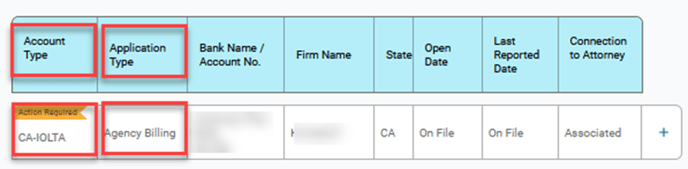
Please see the tables, below, to see the Account Type and the Application Type (the application through which the account must be registered) (see Image 1) for each response to the Step 1 questions.
Image 1. My State Bar Profile Step 2 Account Registration Grid
|
Step 1 Question 1 (IOLTA) Responses |
Account Type Required in Step 2 |
Application Type (Registered Through) |
|
“Yes, I will provide or update IOLTA (or similar pooled) account information, including the balance as of December 31, 2025, via My State Bar Profile…” |
CA IOLTA or Non-CA IOLTA |
My State Bar Profile |
|
“Yes, a firm or organization I am currently employed by or in practice with will provide or update IOLTA (or similar pooled)account information, including the balance as of December 31, 2025, via Agency Billing…” |
CA IOLTA or Non-CA IOLTA |
Agency Billing |
|
“Yes, however, I am no longer employed by or in practice with the firm or organization. I understand that I am not required to register trust accounts that are maintained by a firm or organization that I am no longer employed by or in practice with as of December 31, 2025.” |
No account registration required. |
- |
|
“No, I did not maintain an IOLTA or similar pooled trust account in another jurisdiction, and no firm maintained one on my behalf, but I did maintain a non-IOLTA trust account or a non-IOLTA trust account was maintained on my behalf.” |
No account registration required. |
- |
|
Step 1 Question 2 (Non-IOLTA) Responses |
Account Type Required in Step 2 |
Application Type (Registered Through) |
|
“Yes, I will provide or update non-IOLTA account information,, including the balance as of December 31, 2025, via My State Bar Profile...” |
Non-IOLTA |
My State Bar Profile |
|
“Yes, a firm or organization I am currently employed by or in practice with will provide or update the non-IOLTA account information via Agency Billing…” |
Non-IOLTA |
Agency Billing |
|
“Yes, however, I am no longer employed by or in practice with the firm or organization. I understand that I am not required to register trust accounts that are maintained by a firm or organization that I am no longer employed by or in practice with as of December 31, 2025.” |
No account registration required. |
- |
|
“No, I did not maintain a non-IOLTA or similar trust account in another jurisdiction, and no firm maintained one on my behalf, but I did maintain an IOLTA or an IOLTA was maintained on my behalf.” |
No account registration required. |
- |
(3.2.3) I am a sole practitioner and have a legal entity (e.g., APC, Law Offices, etc.). For the questions in Step 1 (Annual Client Trust Account Reporting), do I answer that I will provide or update the account information via My State Bar Profile or that a firm will provide or update the account information via Agency Billing?
As a sole practitioner, you likely maintain the account yourself or have a bookkeeper maintain the account and have access to the account information (e.g., routing number, account number, balance, etc.). If so, you can provide or update the account information via My State Bar Profile.
The “a firm or organization I am currently employed by or in practice with will provide or update the account information via Agency Billing” option is for lawyers who do not have access to the account information and who have a firm administrator who uses the State Bar’s Agency Billing platform, and the administrator will register the firm trust accounts on behalf of the firm lawyers. If this applies to you, you may select that answer in Step 1 and, in Step 2 (Account Registration), if the firm administrator has not already registered the account details, you will select the checkbox next to “My firm or organization administrator informed me that the IOLTA and/or Non-IOLTA account details will be reported by my firm or organization on my behalf through the State Bar's Agency Billing application. I understand that it is my responsibility to ensure that my CTAPP reporting is complete, including that my firm or organization reports any account details maintained on my behalf.” It is your responsibility to ensure that all necessary account details are registered, including the December 31 balance. You should be sure to confirm with your firm administrator that they will register the required information via the State Bar’s Agency Billing platform by the deadline.
(3.3) Step 2: Account Registration
(3.3.1) How do I register my trust accounts in My State Bar Profile?
For help registering your trust accounts in Step 2 of CTAPP in My State Bar Profile, please see the Client Trust Account Updates Guide.
(3.3.2) The bank holding my trust account was acquired by or merged with another bank. My routing number and account number haven’t changed, but the bank name has changed. How do I report this change to my account?
The State Bar is in the process of updating all bank names according to the names listed in the official Registrar of Routing Numbers for the American Bankers Association. Therefore, if your bank name changed, but your routing number and account number stayed the same, the State Bar will update the bank name to your existing trust account record. You do not need to do anything to change the bank name. You will still need to provide the year-end balance for your existing trust account.
(3.3.3) The bank holding my trust account was acquired by or merged with another bank. The new bank changed my routing number and/or account number, but I cannot update those fields during my CTAPP reporting. How do I report this change to my account?
The trust account reporting system does not allow changes to routing numbers or account numbers of previously registered trust accounts. To report this change, please close the registration of the existing account by clicking the “Update Account Information” link and then entering, in the "Edit Close Date” tab, the date the account was changed to the new routing and account number. You will also need to enter the balance on that date.
You can then register the account with the new routing number and account number. In the open date field, please enter the date the account was changed to the new routing and account number. Please be sure to enter the bank balance of the new account as of December 31.
(3.4) Step 3: Self-Assessment
(3.4.1) Where can I see the questions I will be asked during the self-assessment?
The CTAPP self-assessment questions can be viewed in the CTAPP self-assessment preview.
(3.4.2) The self-assessment asks about tasks that I do not personally perform (e.g., conducting a monthly reconciliation) but I believe other persons in my firm are responsible for those tasks. How do I complete those items in the self-assessment?
A subordinate lawyer may consult a supervisory lawyer to confirm that duties that are not personally performed are being properly discharged by others in the firm. For example, a subordinate lawyer may ask the attorney who manages the firm’s client trust accounts whether monthly reconciliations are performed on the client trust accounts.
Absent information to the contrary, the subordinate lawyer may reasonably rely on that guidance in completing the self-assessment.
Rule of Professional Conduct 5.1
Rule of Professional Conduct 5.2
(3.4.3) Why am I being required to take a self-assessment on client trust accounting practices, and is it a wrong answer if I respond “no” to any of the self-assessment items?
The required self-assessment is a tool to help attorneys evaluate their current practices and to provide citations to relevant rules and other references, including sections of the Handbook on Client Trust Accounting for California Attorneys. The objective is to promote awareness of duties and facilitate thoughtful consideration of any possible changes to an attorney’s current practices.
Given the great variety of practice settings, including situations where an attorney’s practice is conducted in part or completely in another state with different rules, an attorney might appropriately respond “no” to a self-assessment item. Responding “no” should not be considered a wrong answer when that response accurately reflects an attorney’s current practices. However, if you respond “no” to any question, you may want to consider carefully whether you should make changes to your trust account management practices. Even if you decide not to change your trust account management practices, you should consider documenting in your records the purpose of any “no” responses. The self-assessment questions may be reviewed if you are selected for a compliance review. Documentation will assist the reviewer to quickly understand the purpose of the firm’s practice.
In taking the self-assessment, if an attorney is unsure about how California rules and recordkeeping standards apply to a specific practice setting, an inquiry to the Ethics Hotline research service at 800-238-4427 (toll-free in California) can be helpful. The Ethics Hotline might be able to provide more citations and resource references than the ones included in the self-assessment. The Ethics Hotline cannot provide legal advice, nor tell you how to comply with any of the CTAPP requirements, including the self-assessment.
Only by thoughtfully and honestly completing the self-assessment will an attorney realize the benefits of this compliance tool. Please keep in mind that the self-assessment questions are framed in the present tense and as such, they do not elicit information about prior conduct. Most importantly, what is learned from the self-assessment should inform an attorney’s future conduct in providing competent and professionally responsible services when handling funds and property of clients and others.
(3.5) Final Declaration
(3.5.1) Instead of the final declaration, I get an “Outstanding Reporting Requirements” warning that says, “Step 2: Account Registration is incomplete based on your responses in Step 1” and that I need to register client trust accounts maintained during the reporting period OR indicate why I am unable to provide account information using the options at the bottom of the Why am I getting this error?
Please check to make sure all of your accounts have been registered in Step 2. If all your accounts have been registered, the required account ending balance may be missing in Step 2. You must provide the account ending balance as of December 31 of the reporting period or the date the account was closed.
If all your accounts have been registered and each account has a balance, please review your responses in Step 1. If you chose multiple “Yes” answers requiring trust account registration, for example, in Step 1, in response to question 1 (IOLTAs), you selected, “Yes, I will provide or update IOLTA (or similar pooled) account information, including the balance as of December 31, 2025, via My State Bar Profile . . .” and, in response to question 2 (non-IOLTAs), you also selected “Yes, I will provide or update non-IOLTA account information, including the balance as of December 31, 2025, via My State Bar Profile . . .,” based on your selected responses you are required to register both an IOLTA and a non-IOLTA trust account via My State Bar Profile. If you only have one trust account, please revise your response to either question 1 or question 2. A trust account can never be both an IOLTA and a non-IOLTA.
Similarly, if you selected multiple “Yes” responses requiring trust account registration to question 1 (e.g., “Yes, I will provide or update IOLTA account information, including the balance as of December 31, 2025, via My State Bar Profile” and “Yes, a firm or organization I am currently employed by or in practice with will provide or update IOLTA account information, including the balance as of December 31, 2025, via Agency Billing . . .”), based on your selected responses you are required to register multiple IOLTAs via My State Bar Profile and Agency Billing. If you only have one IOLTA, please revise your responses to question 1 in Step 1.
Requirements for Lawyers Practicing in Multiple Jurisdictions/Outside California
(4.1) I am licensed in multiple jurisdictions, and I maintain an active California license; however, I do not represent any California clients, I do not have any matters pending in California, and I do not have any client funds in California or any funds from clients in California. Do I need to report my out-of-state accounts?
Unless exempt (see FAQ 2.3, above), California licensees, regardless of where they practice, must still comply with the CTAPP reporting requirements. To answer Step 1 (Annual Client Trust Account Reporting) questions, licensees must determine whether they are responsible for client funds and funds entrusted by others under the provisions of rule 1.15 of the California Rules of Professional Conduct. (See Rules Prof. Conduct, rule 8.5.) If so, because rule 1.15 of the California Rules of Professional Conduct requires attorneys who handle trust funds to hold those funds in one or more client trust accounts labeled as a “Trust Account,” or words of similar import, the licensee must answer “yes” to at least one of the CTAPP Annual Client Trust Account Reporting questions of whether they maintained any trust accounts under Business and Professions Code section 6211, subdivision (a) where the interest is paid to the State Bar, also known as an Interest of Lawyer’s Trust Account (IOLTA) or trust accounts under Business and Professions Code section 6211, subdivision (b) where the interest is payable to a client or other person, also known as non-IOLTA trust accounts, and complete the remaining CTAPP requirements.
Only if the licensee is not responsible for any client funds and funds entrusted by others under rule 1.15 of the California Rules of Professional Conduct may the licensee answer “no” to the CTAPP Annual Client Trust Account Reporting questions.
For information on reporting an IOLTA account outside California, please refer to CTAPP FAQ 4.3, below.
Rule of Professional Conduct 1.15
Rule of Professional Conduct 8.5
Business and Professions Code section 6211
(4.2) I am licensed in multiple jurisdictions, and I maintain an active California license. I have clients in California and clients in another jurisdiction, and I maintain client trust accounts in California and another jurisdiction. Do I need to report my client trust accounts located in another jurisdiction?
Unless exempt (see FAQ 2.3, above), California licensees, regardless of where they practice, must still comply with the CTAPP reporting requirements. A licensee who was responsible for client funds and funds entrusted by others under the provisions of rule 1.15 of the California Rules of Professional Conduct must, annually, register each and every trust account in which the licensee held such funds at any time during the reportable time period by identifying account numbers and financial institutions in a manner prescribed by the State Bar for such reporting. There is no exception for out-of-state accounts.
Rule of Professional Conduct 1.15
State Bar Rules, Title 2, Division 1, rule 2.5
(4.3) How do I report IOLTA accounts outside of California?
In general, under rule 1.15(a) of the Rules of Professional Conduct, a licensee’s trust accounts must be maintained in California, or, with the written consent of the client, in another jurisdiction where there is a substantial relationship between the client or the client’s business and that other jurisdiction. Therefore, if licensees are entitled to hold IOLTA accounts outside of California, they will need to register those accounts as Non-CA IOLTA accounts by selecting “Add Account” in My State Bar Profile, or, if using the Agency Billing application, selecting “Manage Accounts.”
Rule of Professional Conduct 1.15
(4.4) I have an IOLTA account outside California. In question 2 of the Step 3 (Self-Assessment), how can I affirm that any funds held in a California IOLTA account are maintained in an IOLTA-eligible institution identified on the State Bar of California’s website if the account is held outside California by an institution that is not on the approved list?
Under Business and Professions Code section 6212, attorneys that established an IOLTA account pursuant to subdivision (a) of Business and Professions Code section 6211, may hold IOLTA accounts only at eligible financial institutions. Rule 1.15(a) of the California Rules of Professional Conduct generally requires that trust accounts for California clients be maintained in California. You are permitted to hold client funds in an IOLTA account outside California if your client is from somewhere other than California or if your California client has a substantial relationship with the other jurisdiction and has provided written consent. If your practice meets those criteria and you do not have a California IOLTA, you may select “I do not have a California IOLTA” as your response.
Business and Professions Code section 6211
Business and Professions Code section 6212
(4.5) Do I need to report non-U.S. bank accounts?
Unless exempt (see FAQ 2.3, above), California licensees, regardless of where they practice, must still comply with the CTAPP reporting requirements. Licensees must report and register each and every trust account in any location if (1) they acted as a signatory or exercised managerial or primary administrative oversight for a trust account held pursuant to rule 1.15 of the California Rules of Professional Conduct or (2) were otherwise responsible for complying with any of the requirements or prohibitions in rule 1.15 of the California Rules of Professional Conduct other than the disclosure and agreement requirements in rule 1.15(b) pertaining to depositing a flat fee paid in advance into a lawyer’s or law firm’s operating account (e.g., responsibilities for safekeeping of funds, to identify and discharge liens, notify clients that funds have been received, etc.).
Currently, CTAPP reporting features do not allow licensees or firm administrators to enter non-U.S. routing and account numbers. Therefore, for all non-U.S. trust accounts, in Step 1 (Annual Client Trust Account Reporting), please check the box next to “Yes, I will provide or update IOLTA and/or non-IOLTA account information, including the balance as of December 31, 2025, via My State Bar Profile” for the appropriate question, depending on the type of account. Then, during Step 2 (Account Registration), check the checkbox next to “Other” under the sentence, “If you selected Yes to the IOLTA or Non-IOLTA question in Step 1, but are unable to register that IOLTA (CA or Non-CA) and/or Non-IOLTA because you do not have some of the required information, please describe why below,” and, in the box provided, list all non-U.S. bank accounts, including bank name, account number, and country of origin. In future years, we expect enhancements to the reporting application will make it possible for licensees and agencies to report non-U.S. trust account information.
Law Firm Reporting
(5.1) Can my firm complete my CTAPP reporting on my behalf?
Law firms and organizations can complete only one step of the requirements for the lawyers who work for them, which is registering trust accounts on their behalf. Even if the firm registers the account on behalf of the lawyer, the lawyers must still log into their My State Bar Profile page and complete the initial report of whether they maintained a client trust account or one was maintained on their behalf, the self-assessment, the certification that they are knowledgeable about and in compliance with the rules regarding the safekeeping of funds and the declaration.
If the firm or organization that you are currently employed by or in practice with is registered with the State Bar’s Agency Billing platform, the firm or organization may register the client trust accounts on the lawyer’s behalf. However, the State Bar must receive the trust account registration data by the reporting deadline. If you or your firm or organization fail to report this information by the deadline, you will be assessed a noncompliance penalty.
Please contact your firm or organization administrator to confirm whether they will report the trust account registration data on your behalf. The firm must identify, via the Agency Billing platform, each licensee who is covered by the firm’s submission of account information on behalf of the firm’s lawyers.
Lawyers can determine whether their firm has reported account information on their behalf during the CTAPP registration process in My State Bar Profile or, if they have already completed their individual reporting requirements, by clicking on the "View a Summary of your CTAPP Annual Reporting” link on the CTAPP Annual Reporting tile on the Compliance Dashboard page.
Related Rules
California Rules of Court, rule 9.8.5
Rules of the State Bar, Title 2, Division 1, rule 2.5 Rules of Professional Conduct 1.4
Rules of Professional Conduct 1.15
Have a question? Contact us.